
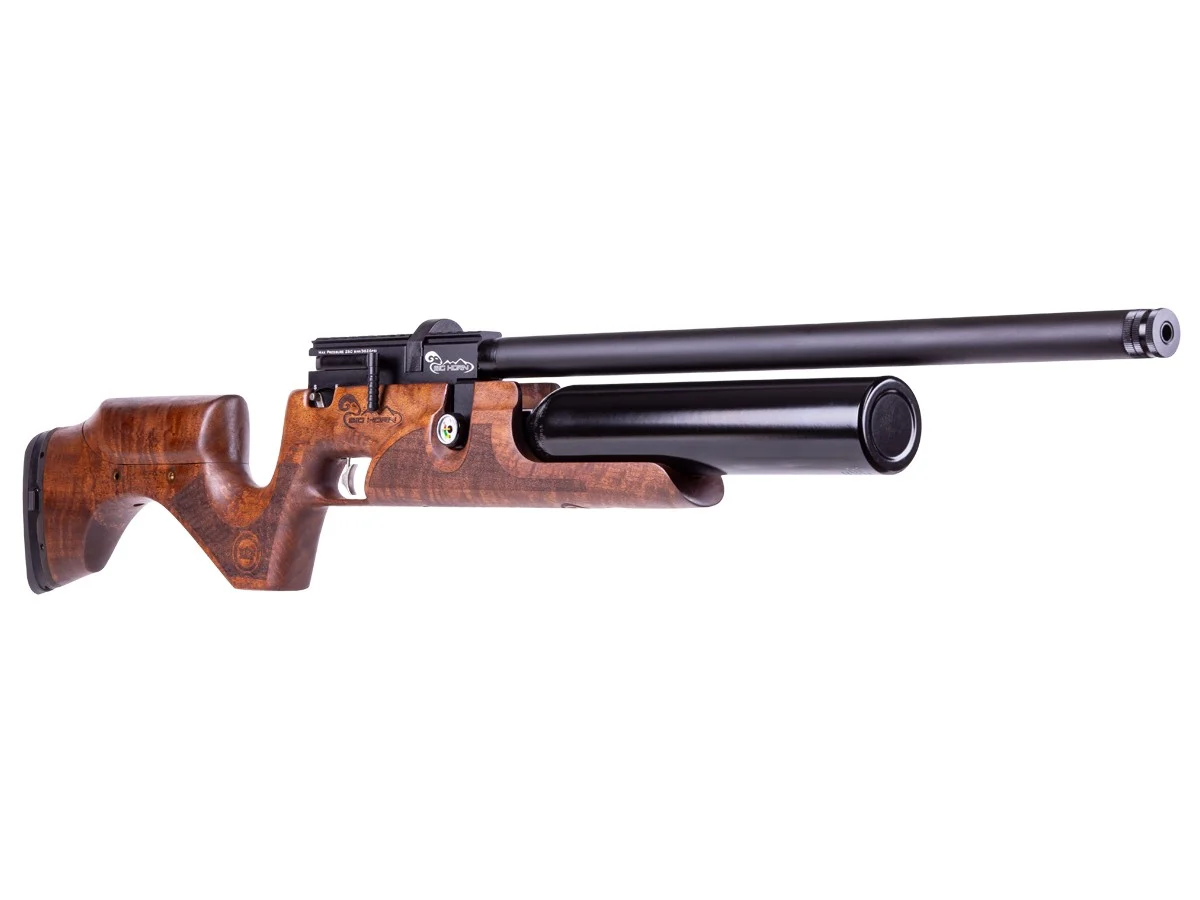
Kral Arms Puncher Bighorn PCP Air Rifle
£500.00
Description
Kral Arms Puncher Bighorn PCP Air Rifle — The Pinnacle of Power, Precision, and Craftsmanship
When precision meets innovation, the result is extraordinary. The Kral Arms Puncher Bighorn PCP Air Rifle stands as a perfect example of modern airgun engineering at its peak. Designed for enthusiasts who crave accuracy, consistency, and performance, this rifle pushes boundaries with its bold presence and unmatched firepower. Every element of its construction speaks to the meticulous craftsmanship and decades of expertise that Kral Arms has poured into perfecting the art of airgun manufacturing.
From the first glance, the Puncher Bighorn PCP captures attention with its powerful design and solid stance. Every curve, cut, and contour embodies purpose — not just aesthetic appeal. This air rifle isn’t merely built to perform; it’s crafted to dominate. Whether you’re target shooting at the range or testing precision in the field, the Bighorn delivers unwavering control, comfort, and accuracy with every shot.
The Heritage Behind Kral Arms — A Legacy of Innovation
For over half a century, Kral Arms has been at the forefront of Turkish firearm innovation. The brand has continually elevated the standard of air rifle performance, integrating advanced technologies with old-world craftsmanship. Each rifle that leaves their factory is a result of rigorous testing, quality control, and dedication to precision engineering.
The Puncher Bighorn PCP Air Rifle reflects that proud legacy. It isn’t just another addition to the Kral lineup — it’s a declaration of power, performance, and versatility. Built for demanding shooters, it merges traditional woodwork or synthetic durability (depending on the variant) with high-pressure air technology that ensures remarkable shot consistency
Kral Arms’ philosophy is simple yet powerful: create air rifles that empower shooters to perform beyond their limits. The Bighorn PCP does precisely that — fusing strength and style in a way that few rifles in its class can match.
A Design That Commands Attention
Every shooter knows the importance of first impressions. The Kral Arms Puncher Bighorn PCP Air Rifle doesn’t whisper — it roars sophistication and power. Its ergonomic design delivers a perfect balance between functionality and aesthetics. The rifle’s frame is built for stability, ensuring minimal recoil while enhancing shooter comfort during extended sessions.Kral Arms Puncher Bighorn PCP Air Rifle
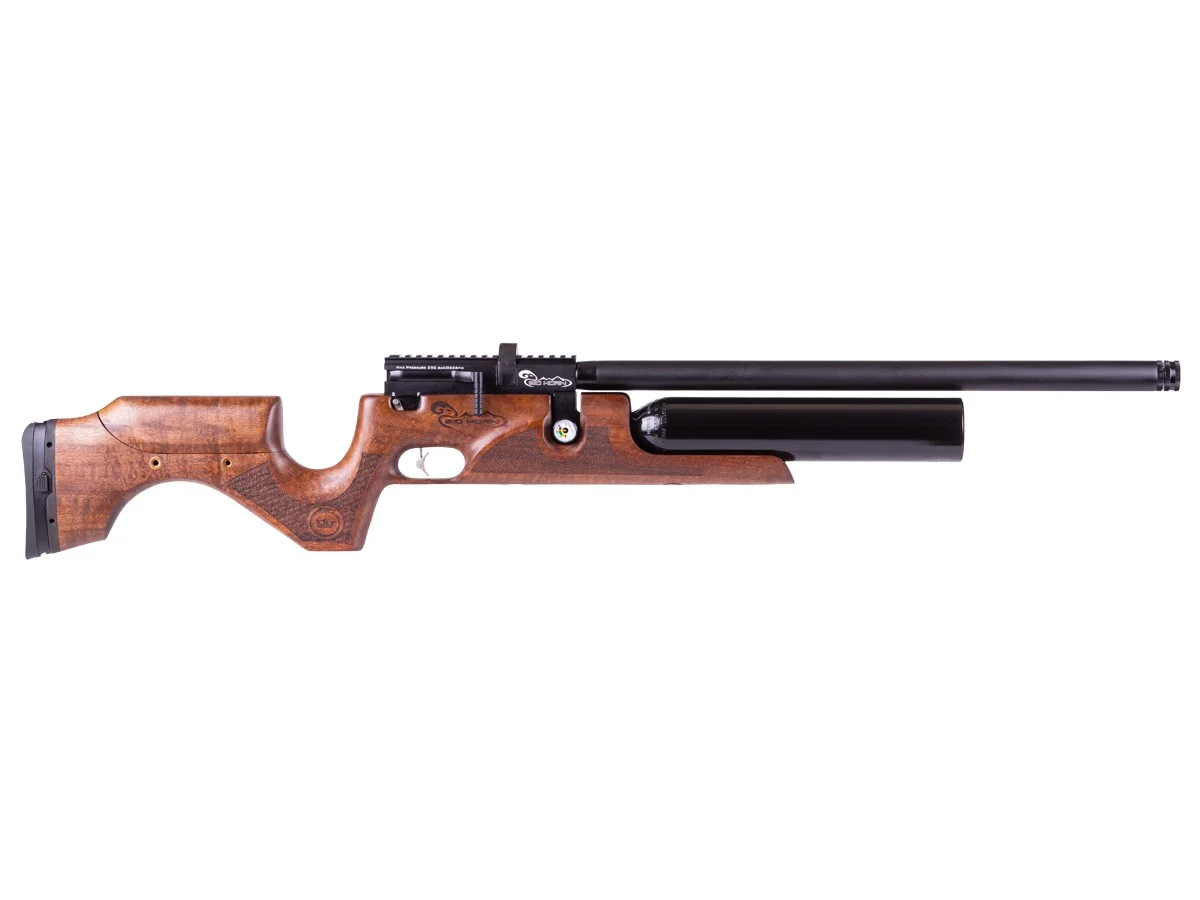
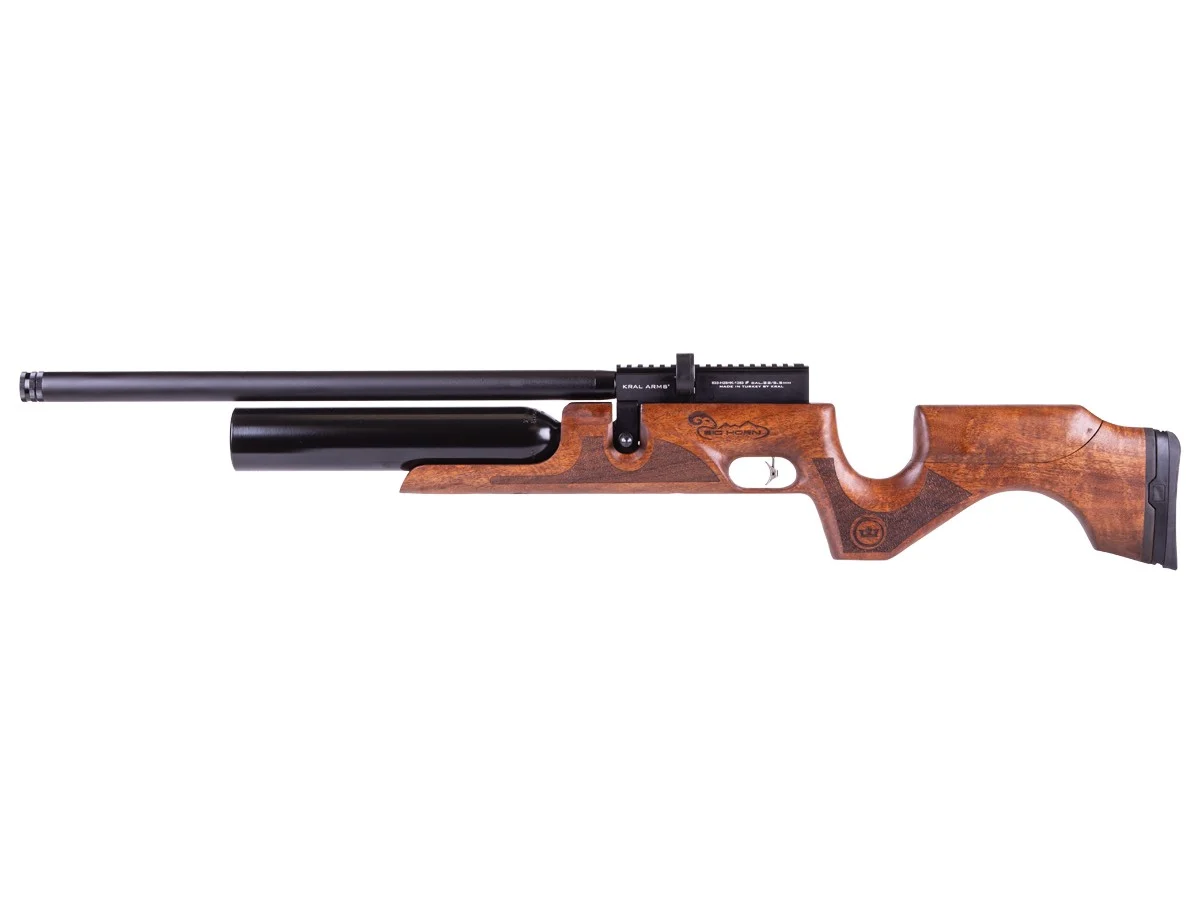
The stock options — whether you choose the finely finished Turkish walnut or the rugged synthetic version — define your shooting experience. The walnut variant exudes classic appeal, ideal for those who appreciate traditional craftsmanship. Meanwhile, the synthetic model offers resilience and weather resistance for shooters who demand performance under all conditions.Kral Arms Puncher Bighorn PCP Air Rifle
Beyond aesthetics, every inch of this air rifle is meticulously engineered for performance. The carefully balanced stock ensures seamless shoulder alignment, while the adjustable cheek piece promotes precision aiming. Additionally, its well-placed trigger guard, large bolt lever, and secure grip give shooters the confidence to handle the rifle smoothly in any shooting environment.Kral Arms Puncher Bighorn PCP Air Rifle
Kral Arms Puncher Bighorn PCP Air Rifle Power That Redefines Performance
Performance is where the Kral Arms Puncher Bighorn PCP Air Rifle sets itself apart from the competition. This air rifle is not just about looks — it’s about unrelenting power combined with pinpoint control. Equipped with a high-capacity air reservoir, it delivers consistent shots over extended sessions without requiring constant refills. That means more time focusing on accuracy and less time managing air supply.
Kral Arms Puncher Bighorn PCP Air Rifle Key Performance Highlights
-
Caliber Options: Available in multiple calibers such as .177, .22, and .25, offering flexibility for different shooting applications.
-
High Velocity Output: Capable of reaching velocities up to 1250 FPS, ensuring long-range accuracy and clean target penetration.
-
Regulated Power System: Designed for consistency, it ensures each shot maintains uniform air pressure for precise results.
-
Large Air Cylinder: Offers extended shot count per fill — perfect for long shooting sessions without interruptions.
-
Two-Stage Adjustable Trigger: Allows shooters to fine-tune trigger sensitivity for maximum control and comfort.
The balance between power and precision defines the Bighorn PCP. Each component works harmoniously to provide the shooter with a smooth, reliable experience. The rifle’s innovative air management system ensures efficiency, while its internal regulator helps maintain consistent muzzle velocity from the first shot to the last.
Kral Arms Puncher Bighorn PCP Air Rifle Comfort, Control, and Confidence
While power matters, control is everything. The Puncher Bighorn PCP Air Rifle excels in delivering a shooting experience that feels natural and intuitive. Its stock design, ergonomic grip, and perfectly balanced weight distribution allow the shooter to maintain a steady aim without fatigue.
Kral Arms Puncher Bighorn PCP Air Rifle Comfort Features That Elevate the Experience
-
Adjustable Cheek Piece: Enables a customized fit for perfect sight alignment.
-
Rubber Butt Pad: Absorbs recoil and enhances shoulder comfort during extended sessions.
-
Lightweight but Durable Construction: Offers exceptional handling even during prolonged use.
-
Precision-Cut Checkering: Provides a secure grip in all weather conditions.
Every design detail contributes to the feeling of unity between shooter and rifle. The Bighorn PCP doesn’t fight you; it complements your movements. The smooth bolt action, responsive trigger, and balanced design give it a level of refinement that many air rifles struggle to achieve.Kral Arms Puncher Bighorn PCP Air Rifle
Kral Arms Puncher Bighorn PCP Air Rifle Built for the Demanding Shooter
The Kral Arms Puncher Bighorn PCP Air Rifle isn’t built for the average enthusiast — it’s crafted for those who demand performance beyond compromise. It’s for shooters who view precision as non-negotiable and expect their equipment to match their ambition.
This rifle performs seamlessly across various shooting disciplines. Whether it’s long-distance target shooting, pest control, or hunting small game, the Bighorn adapts effortlessly. Its quiet operation, impressive shot capacity, and powerful impact make it a top-tier choice for those who take shooting seriously.
Kral Arms Puncher Bighorn PCP Air Rifle A Symbol of Strength and Precision
Every shot fired from the Puncher Bighorn PCP Air Rifle tells a story of engineering mastery. It’s more than just a high-powered PCP rifle; it’s a symbol of strength, resilience, and perfection. The rifle’s performance is not only measurable — it’s deeply felt with every trigger pull.
The Bighorn represents more than a tool for shooting — it embodies confidence. It encourages shooters to embrace their potential and discover how technology can amplify skill. Every mechanical movement, from the bolt to the air regulator, is fine-tuned to ensure that the rifle performs with military-grade reliability.
Kral Arms Puncher Bighorn PCP Air Rifle Understanding Ballistics: From Muzzle to Target
Ballistics is where theory meets the field. Projectile flight depends on initial velocity, pellet shape and mass, atmospheric conditions, and the rifle’s inherent consistency. By mastering those variables, you gain predictable trajectories and tighter groups.
Kral Arms Puncher Bighorn PCP Air Rifle Key ballistic concepts
-
Muzzle velocity (MV): The pellet’s speed as it leaves the barrel. Higher MV usually flattens trajectory but can increase pellet instability if the twist rate or pellet form is inappropriate.
-
Ballistic coefficient (BC): A measure of how well a pellet resists air drag. Higher BC pellets retain velocity and resist wind more effectively.
-
Time of flight (TOF): The duration the pellet spends in the air; shorter TOF reduces wind error.
-
Drop and holdover: The vertical compensation required at varying ranges; quantified in inches, centimeters, or milliradians.
-
Wind drift: Horizontal displacement caused by crosswind; heavier and streamlined pellets drift less.
Mastering these factors turns educated guesses into repeatable corrections. For example, choosing a heavier pellet with a suitable BC often reduces wind drift and stabilizes point-of-impact at extended ranges.
Pellet Selection: Matching Pellet to Platform
Pellets differ in shape, weight, and construction. The Puncher Bighorn’s barrel harmonics and twist rate will favor certain pellet profiles in each caliber. Practical testing always beats theory, but the following guidance narrows the field quickly.
Pellet profiles to consider
-
Domed (round-nose) pellets: Best for long-range accuracy and hunting. They usually offer the best BC in a given caliber.
-
Hollow point pellets: Deliver expansion on impact; ideal for humane hunting at moderate ranges.
-
Wadcutter / flat-head pellets: Excellent for paper-target precision at close range; not optimal long-range choices.
-
Pointed pellets: Sometimes achieve higher BC but are often less forgiving in rifling and can be sensitive to seating depth.
Recommended approach
-
Start with three top-quality domed pellets in each caliber you plan to use (example weights: .177 — 7.9–8.5 gr; .22 — 14–16 gr; .25 — 25–30 gr).
-
Test each pellet across a range of velocities within the rifle’s regulator plateau to find the sweet spot where groups tighten.
-
Prioritize pellets that show low standard deviation (SD) in velocity and produce the tightest 5-shot groups at the preferred distance.
Testing Methodology: A Repeatable Protocol
Consistency in testing separates anecdote from data. The following protocol produces defensible results you can act on.
Controlled test setup (baseline)
-
Use a stable bench or solid rest to eliminate shooter error during the initial tests.
-
Mount a reliable scope that’s properly zeroed.
-
Record ambient conditions: temperature, humidity, pressure, and wind. These affect MV and BC.
-
Use a chronograph placed 2–3 feet from the muzzle to measure shot velocity.
-
Fire five-shot strings for each pellet/velocity configuration, allowing the regulator to settle between strings.
Step-by-step test procedure
-
Begin with a thorough rifle warm-up: fire 3–5 shots to stabilize the regulator and barrel harmonics.
-
Load the chosen pellet and fire a 5-shot string while logging velocities and group size.
-
Change pellet type or adjust fill pressure according to your test matrix and repeat.
-
After completing strings for all pellets, compute mean velocity, standard deviation (SD), and group mean radius for each configuration.
-
Rank configurations by SD and group consistency; low SD and small group size win.
What to measure and why
-
Mean MV: Helps calculate trajectories and energy.
-
SD (fps): Lower SD indicates better shot-to-shot consistency.
-
Group size (MOA/cm): Directly measures accuracy.
-
Shot count per fill at chosen power: Practical metric for field use.
By sticking to this protocol, you’ll find the pellet and tune best suited to your shooting goals, whether competition, pest control, or hunting.
Ballistic Calculation & Zeroing
Translating MV and BC into a usable holdover table makes long-range shooting manageable. You can use ballistic calculators or scope reticle subtensions to generate drop charts.
Practical zero strategy
-
Zero the rifle at 25–30 meters for hunting/field use, which gives a useful point-blank range for many small-game scenarios.
-
Alternatively, zero at 50 meters for match or long-range recreational shooting, then use holdover or elevation adjustments for beyond.
-
Produce a simple range card noting holdover (in clicks or mils) for 25, 50, 75, 100, and 150 meters based on the tested pellet’s MV and BC.
Wind and Environmental Compensation
Wind is the single most disruptive factor at distance. Train with controlled wind drills and learn to translate observed flags and mirage into drift estimates.
Wind-reading rules of thumb
-
Light breeze (3–6 mph) causes modest drift at 50–75 m with heavy domed pellets.
-
Moderate wind (6–12 mph) becomes significant beyond 75 m and requires larger holds.
-
Gusting winds demand waiting for steady conditions or applying a safety margin in aim.
Practically, practice shooting in a variety of wind conditions. Over time, you’ll develop a feel for how much to hold off based on pellet weight and range.
Practical Shooting Drills: Skill Meets Rifle
Testing technical variables is essential, but shooter skill multiplies gun performance. The following drills emphasize fundamentals, follow-through, and repeatability.
Drill: The 5-Shot Consistency Drill
-
Setup target at 25 meters.
-
Using the best pellet from testing, fire five strings of 5 shots each from a bench rest, calling each shot.
-
Rest between strings to avoid fatigue.
-
Analyze group centers and group size; work on any consistent POI shift.
Drill: The 3-Position Field Drill
-
Shoot from standing, kneeling, and sitting positions at 30 meters.
-
Use the same pellet and sight picture for each position.
-
Focus on smooth trigger release and positive follow-through.
-
Record group sizes for each position to identify weakest stances.
Drill: Rapid Follow-Up Accuracy
-
Place a steel target at 25–35 meters.
-
Fire one aimed shot; re-acquire and fire a second within 3–5 seconds.
-
Practice until both hits fall in the kill zone repeatedly.
These drills reinforce fundamentals and simulate field conditions. Gradually increase distance and add wind or target movement to challenge your skills.
Accuracy Tuning: Iterative Adjustments
Tuning is a methodical process. Make one change at a time and retest to isolate effects.
Tuning checklist
-
Pellet choice: Confirm best pellet by SD and group size.
-
Regulator pressure: Slightly adjust to find the plateau where both SD and group size are minimized.
-
Seating depth: Small variations in seating can tighten groups; keep records.
-
Hammer/valve tuning: If you’re comfortable, change hammer mass or dwell time to refine valve behavior.
-
Barrel harmonics: Try different muzzle devices or a barrel weight to see harmonic effects.
-
Trigger setup: Fine-tune take-up and pull weight to your preference.
-
Scope and mounts: Ensure mounts are torqued correctly and scope rings are solid; a loose mount destroys groups.
Troubleshooting common issues
-
Vertical stringing: Often caused by inconsistent valve/regulator output or changing pellet velocity; re-check regulator and gauge.
-
Horizontal spread: Frequently a result of wind or inconsistent shooter technique; run stabilization drills.
-
Single flyer in group: Check pellet consistency and seating; inspect for damaged pellets or a dirty barrel.
Document each change and retest using the controlled protocol described earlier. Over time, small, well-documented adjustments compound into substantial accuracy gains.
Practical Maintenance Tips to Preserve Ballistic Consistency
A predictable rifle is a maintained rifle. Routine care sustains consistency.
Technical Design & Performance Breakdown
Engineering Overview: Built from Purpose
The Kral Arms Puncher Bighorn PCP Air Rifle was engineered with a clear objective: translate stored pneumatic energy into repeatable, precise muzzle velocity while minimizing mechanical disturbance. To accomplish that, Kral Arms combined robust materials, refined tolerances, and thoughtful ergonomics. Every subsystem — from the regulator to the barrel — plays a role in ensuring consistency shot after shot.
Core engineering goals
-
Maintain consistent muzzle velocity across many shots.
-
Reduce mechanical and human-caused variance in point-of-impact.
-
Enable customization so shooters can tune performance to their preferences.
-
Ensure durability and serviceability for long-term ownership.
Action and Bolt System: Smooth, Secure, Fast
A reliable action is the backbone of any precision air rifle. The Puncher Bighorn features a large, user-friendly bolt with smooth travel and positive lock-up. Designed for quick cycling and minimal shooter disturbance, the bolt system lowers the chance of follow-through errors.
Bolt features
-
Oversized bolt handle for fast, confident cycling.
-
Precise machining ensures consistent lock-up and alignment.
-
Low-friction surfaces reduce shooter-induced movement during loading.
-
Robust construction for longevity under repeated use.
Because the bolt returns to the same seating position each time, group-to-group dispersion improves. Moreover, the user’s ability to cycle the action quickly makes follow-up shots simpler without sacrificing accuracy.
Barrel Engineering: The Heart of Accuracy
Barrel design determines much of a rifle’s accuracy potential. Kral Arms selected high-grade steel for the barrel and employed tight tolerances during rifling. The bore finish, twist rate, and harmonic control were optimized to stabilize pellets across the commonly offered calibers (.177, .22, .25).
Barrel design highlights
-
Material: High-quality chromoly or stainless steel (depending on production batch).
-
Rifling: Precision-cut rifling matched to pellet diameters for uniform spin stabilization.
-
Length & contour: Tuned to balance muzzle velocity and harmonic stability.
-
Crown: Carefully machined crown for symmetric gas release and reduced dispersion.
Because harmonics influence point-of-impact, the barrel and mounting system were designed to control vibration. Additionally, when a moderator or shroud is attached (on models that accept one), backpressure and muzzle harmonics remain stable, improving consistency in both noise suppression and accuracy.
Regulator & Air Management: Consistency Engineered
A regulator is vital for accuracy in high-performance PCP rifles. The Puncher Bighorn uses an internal regulator that meters output to a consistent working pressure before the valve opens. As a result, each pellet gets nearly identical air volume and pressure, dramatically reducing shot-to-shot velocity variance.
Air system components
-
High-capacity air reservoir: Extends usable shot count per fill.
-
Precision regulator: Stabilizes working pressure for consistent muzzle velocities.
-
Pressure gauge (integrated): Provides real-time pressure data for the shooter.
-
Refill port (male/female fitting options): Accepts mainstream fill adapters and hand pumps.
-
Safety valves and over-pressure protections: Prevent user error or catastrophic failure.
Together, these parts create a system where a shooter enjoys long strings of consistent velocities. The practical result is a tight velocity spread (low standard deviation), which equates to repeatable point-of-impact at range.
Valve Design & Firing Cycle: Tuned for Efficiency
The firing valve governs how air is delivered behind the pellet. Kral Arms developed a valve assembly for the Puncher Bighorn that opens and closes with predictable timing and minimal excess air bleed. The valve’s response, when combined with the regulator, produces efficient use of the reservoir while minimizing the variability that can undermine groups.Bighorn air rifle review
Valve system advantages
-
Fast, repeatable valve response time.
-
Minimal hammer bounce due to optimized mass and spring rates.
-
Easy maintenance access for tuning and service.
-
Tolerant design that works well with a range of tuning adjustments.
Because the valve system is approachable for experienced tuners, shooters can finesse performance — optimizing shot count, energy, or quietness according to mission profile.
Trigger System: Precision Control
An adjustable, two-stage trigger is central to bringing a rifle’s accuracy potential to life. The Puncher Bighorn offers a finely adjustable trigger that allows shooters to dial in take-up, pull weight, and blade overtravel. This level of control reduces human error and encourages confident, precise shots.
Trigger features
-
Two-stage adjustability: Fine-tune stage one and stage two to personal preference.
-
Crisp break: Minimal creep when properly set and maintained.
-
Safety integration: Manual safety that reliably blocks the sear without affecting trigger geometry.
-
Durability: Hardened parts with smooth surfaces for consistent performance under high shot counts.
When the trigger break is predictable and short, shooters experience less disturbance at the shot release and therefore tighter groups.
Stock Interface & Bedding: Stability Matters
The way a barreled action sits inside the stock affects accuracy. Kral Arms used bedding methods and stock geometry that minimize movement and straining under recoil or handling.
Stock and bedding notes
-
Reinforced bedding points provide consistent action alignment.
-
Adjustable cheekpiece and length-of-pull accommodate different shooter physiques and shooting styles.
-
Free-floating barrel (where applicable) reduces stock-induced harmonic distortion.
-
High-quality materials prevent warping and degrade slowly with environmental exposure.
As a result, point-of-impact shift from shot-to-shot and across temperature/humidity changes remains minimal.
Sound Suppression & Muzzle Devices
Many shooters value quiet operation. The Puncher Bighorn either ships with or accepts moderators that lower muzzle report without altering harmonics significantly. The interface between barrel and moderator is engineered to keep concentricity and gas flow balanced so accuracy doesn’t suffer.
Muzzle device considerations
-
Threaded barrel options for easy moderator attachment.
-
Concentric mounting to preserve barrel harmonics.
-
Modular designs that allow upgrades without gunsmithing.
When noise suppression is desired, the rifle adapts without trading away precision.
Performance Metrics: What Shooters Can Expect
Numbers matter because they translate engineering into real-world outcomes. While exact results vary with pellet choice, atmospheric conditions, and tuning, typical performance benchmarks for a well-set-up Kral Arms Puncher Bighorn PCP Air Rifle look like this:
-
Velocity stability: Velocity spreads under 8-12 fps across the regulator plateau in many setups.
-
Energy: Depending on caliber and tune, the rifle can produce from moderate hunting power to high-energy long-range impact.
-
Accuracy: Sub-MOA group potential with premium pellets in .22 and .25 calibers at bench-rest distances.
-
Shot count per fill: High-capacity cylinder yields a competitive shot count at regulated power levels.
-
Shot-to-shot consistency: Regulated output and tuned valve translate into predictable trajectories and minimal vertical stringing.Kral Arms Puncher
Those figures are achievable when the rifle is properly broken-in, maintained, and paired with quality pellets and optics.Kral Arms Puncher
Kral Arms Puncher Optics, Mounting, and Accessory Integration
A rifle is only as good as the sights allowing the shooter to use it. The Puncher Bighorn comes with user-friendly mounting options that accept a range of scope rail heights and accessory placements. Kral Arms considered the modern shooter’s kit; as such, rail space and clearance work well with large-scope objective lenses and backup irons.
Kral Arms Puncher Accessory compatibility
-
Railed top deck for secure scope mounting.
-
Multiple sling swivel points for varied carry styles.
-
Optional picatinny segments for bipods or lasers.
-
Spare parts availability to support aftermarket enhancements.
Because modularity was built into the design, shooters can outfit the rifle for bench, field, or hunting scenarios quickly and confidently.
Kral Arms Puncher Maintenance and Serviceability
Long-term ownership depends on how easily the rifle can be serviced. Kral Arms designed the Puncher Bighorn with accessible service points. Common maintenance tasks such as valve inspection, regulator checks, and stock adjustments are straightforward for competent technicians.
Kral Arms Puncher Maintenance highlights
-
User-accessible fills and gauges to inspect system health.
-
Replaceable seals and O-rings with documented service intervals.
-
Modular valve and regulator assemblies to reduce downtime.
-
Clear documentation for routine maintenance and troubleshooting.
A rifle that’s easy to maintain will continue to deliver consistent performance over years of use.
Kral Arms Puncher Tuning Potential: Versatility for Enthusiasts
For shooters who enjoy tuning, the Puncher Bighorn offers numerous avenues: regulator pressure adjustment, valve spring swaps, hammer mass changes, and different pellet/payload combinations. That flexibility allows shooters to prioritize quietness, extreme accuracy, or maximum power depending on mission needs.Kral Arms Puncher
Kral Arms Puncher Tuning paths
-
Regulator re-pressure for shot-count vs. power tradeoffs.
-
Valve dwell tuning for shot efficiency and energy control.
-
Barrel harmonics adjustment via muzzle device or barrel hanger tweaks.
-
Trigger refinement to achieve personal preference.
Because the platform is tolerant and modular, both novice tuners and seasoned gunsmiths will find meaningful improvements within reach.Turkish PCP air rifle
Kral Arms Puncher Real-World Use Cases & Performance Scenarios
The Kral Arms Puncher Bighorn PCP Air Rifle thrives across mission profiles. In field hunting, its power and quiet operation combine for ethical, effective shots. On the range, the regulated system and refined barrel translate to repeatable aggregates. For pest control, shot-to-shot consistency and reliable follow-up make it a practical tool.Turkish PCP air rifle
Kral Arms Puncher Bighorn PCP Air Rifle Representative scenarios
-
Long-range target shooting: Stable velocities and premium pellets yield tight groups.
-
Small-to-medium game hunting: Energy and accuracy deliver humane performance when placed correctly.
-
Pest control: Rapid follow-up and consistent impact make short work of even challenging engagements.
-
Competition / match use: When tuned, the rifle can compete with other high-end PCP platforms.
Each scenario benefits from slightly different setups — a fact made easy by the rifle’s modularity and tuning-friendly architecture.Kral Arms Puncher Bighorn PCP Air Rifle
Additional information
| Caliber | .22 (5.5mm), .25 (6.35mm), .30 (7.62mm), .357 (9mm) |
|---|
Related products
-
-
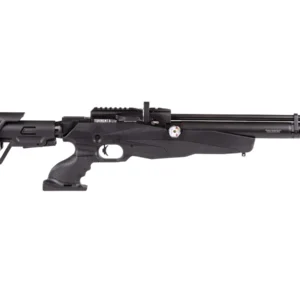
Reximex Tormenta Lite PCP Air Rifle
£200.00Select options This product has multiple variants. The options may be chosen on the product page -
-
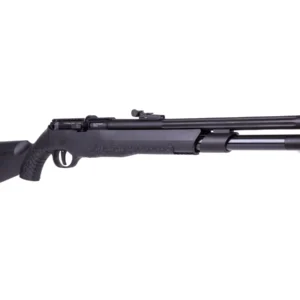
JTS AirStryke PCP Air Rifle
£139.00Select options This product has multiple variants. The options may be chosen on the product page
Reviews
There are no reviews yet.